
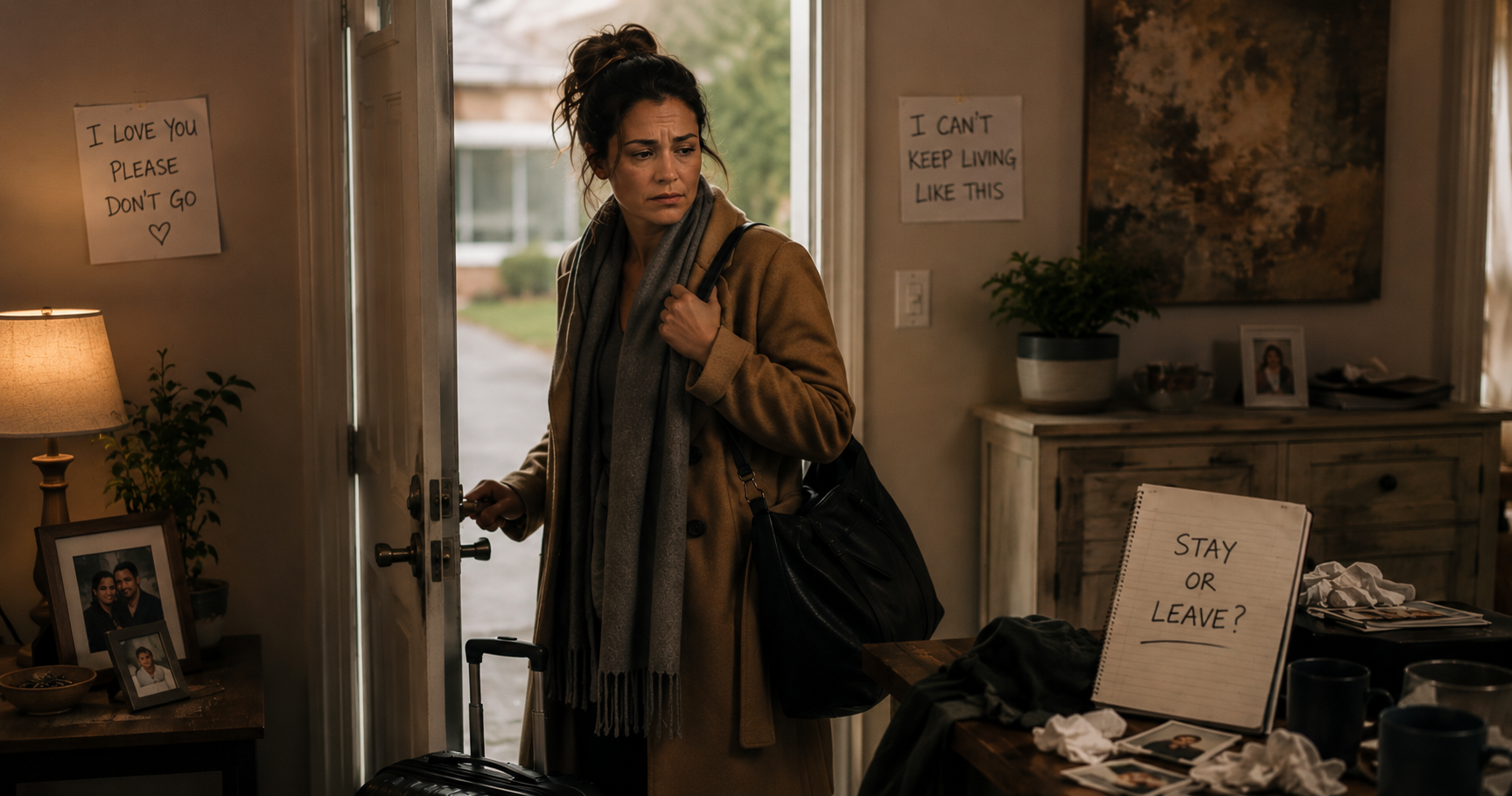
Most people assume the hardest relationship decision is leaving.
For others, they assume the hardest decision is staying.
But many couples discover something else entirely.
The hardest place to live is somewhere in the middle.
Not fully committed.
Not fully gone.
Just stuck.
Waking up every day asking the same question:
"Should I stay?"
"Should I leave?"
"Can this be fixed?"
"Am I wasting my time?"
"What if I regret the decision?"
The relationship becomes less about living and more about evaluating.
And over time, that process carries its own cost.
Most people don't make the decision once
People often imagine relationship uncertainty as a single crossroads.
A difficult conversation.
A major decision.
A moment of clarity.
For many couples, that's not what happens at all.
Instead, the decision gets made repeatedly.
Every argument.
Every disappointment.
Every hopeful moment.
Every setback.
Every good week.
Every difficult week.
The relationship becomes a constant internal debate.
One day you're convinced things can improve.
The next day you're searching for signs they can't.
Back and forth.
Back and forth.
Sometimes for months.
Sometimes for years.
Limbo slowly changes how you experience the relationship
When you're constantly assessing whether to stay or leave, it becomes difficult to fully invest in either direction.
You stop feeling present.
Every interaction becomes evidence.
Evidence that things are getting better.
Evidence that they're getting worse.
Evidence that you should keep trying.
Evidence that you should give up.
You become less focused on experiencing the relationship and more focused on analysing it.
The problem is that relationships rarely thrive under constant evaluation.
Neither do people.
The hidden cost is often emotional exhaustion
Living in uncertainty requires enormous emotional energy.
You replay conversations.
Question your decisions.
Second guess yourself.
Search for certainty.
Look for reassurance.
Wonder whether you're asking for too much.
Wonder whether you're accepting too little.
Eventually the uncertainty becomes its own source of stress.
Not because you've made the wrong decision.
Because you're carrying the weight of not knowing what the right decision is.
It can start affecting more than the relationship
Most people notice the impact on the relationship first.
What often surprises them is how far the uncertainty spreads.
Confidence starts shrinking.
Patience becomes harder.
Hope feels more fragile.
Future planning feels impossible.
Even simple decisions can feel heavier when a significant part of your emotional energy is tied up in unresolved relationship questions.
Life becomes smaller.
Not dramatically.
Gradually.
Almost without noticing.
You can start losing yourself while trying to save the relationship
This is one of the most painful parts of prolonged limbo.
The focus becomes the relationship.
The conflict.
The uncertainty.
The decision.
The possibility of separation.
The possibility of repair.
Everything revolves around solving the relationship.
Meanwhile, parts of yourself quietly move into the background.
Your interests.
Your confidence.
Your goals.
Your identity outside the relationship.
Your sense of who you are when you're not trying to manage the situation.
The relationship becomes the centre of everything.
And that's a heavy burden for any relationship to carry.
Why people stay stuck
People don't remain in limbo because they're weak.
They stay because both options feel expensive.
Leaving carries obvious risks.
The financial impact.
The impact on children.
The loss of shared dreams.
The uncertainty of starting over.
The grief that follows significant change.
But staying can feel expensive too.
The ongoing conflict.
The loneliness.
The resentment.
The emotional exhaustion.
The feeling that life is passing while nothing really changes.
When both paths feel painful, many people stop moving altogether.
Not because they're comfortable.
Because they're overwhelmed.
The problem isn't uncertainty
Uncertainty is a normal part of significant relationship decisions.
The problem is staying trapped there indefinitely.
Many couples spend years gathering more evidence.
Having the same conversations.
Repeating the same arguments.
Waiting for certainty to arrive.
Often it doesn't.
Because certainty is rarely what creates movement.
Clarity does.
And clarity is different.
Certainty says:
"I know exactly what the future holds."
Clarity says:
"I understand what is happening, what has been tried, what is changing and what isn't."
One is a prediction.
The other is an understanding.
Clarity changes everything
Clarity doesn't automatically save a relationship.
It doesn't automatically end one either.
What it does is reduce confusion.
You stop reacting only to the latest argument.
You start understanding the pattern underneath.
You stop asking whether this week's conflict means the relationship is doomed.
You start looking at the bigger picture.
You become less trapped by fear.
Less trapped by hope.
Less trapped by the emotional swings that come from judging the entire relationship based on what happened yesterday.
And from that place, better decisions become possible.
The goal isn't to stay or leave
Most relationship advice assumes the goal is to save the relationship.
Other advice assumes the goal is to leave it.
Neither is always true.
The goal is clarity.
Because clarity allows people to make decisions based on reality rather than fear, exhaustion, guilt, resentment or wishful thinking.
Sometimes clarity helps couples reconnect.
Sometimes it helps them separate more honestly and respectfully.
Sometimes it helps them realise they've been fighting the wrong battle entirely.
But almost always, clarity is healthier than living indefinitely in the space between staying and leaving.
The cost of limbo is rarely visible at first
That's what makes it so easy to miss.
You don't usually wake up one day and realise you've spent years stuck.
It happens gradually.
One postponed decision at a time.
One more chance.
One more argument.
One more promise.
One more reason to wait.
Until eventually you realise the relationship is no longer the only thing being affected.
Your energy is being affected.
Your confidence is being affected.
Your hope is being affected.
Your life is being affected.
And that's why the hidden cost of the daily stay-or-go decision isn't just the relationship itself.
It's everything that gets put on hold while you're waiting for clarity to arrive.